Xmas 2025 Gen AI experiments
05 January 2026
I had some free time over Xmas, so I decided to use some of it to see if I could use AI creatively, but hopefully in a way that was safe, sustainable and didn't exploit others.
Google was offering a 3 month deal on Gemini Pro, so I signed up, but I'm sure Claude, ChatGPT etc. would have offered a similar experience.
Here are 6 things I tried...
1. Question cards for designers #
Just before I broke for Xmas we had a team day for all the designers in GDS. I'd agreed to run an icebreaker to kick it off, so I had Gemini generate a list of 100 questions and stick them into a simple question card web app.

You can play with the app here.
I asked for a mix of questions; some design-related, some silly, none triggering, and it pretty much nailed it. I think I deleted about 6, but mostly because they were boring.
Then we got into pairs and took it in turns to ask each other questions, using the web app on our phones. Really simple, but it worked well.
Feel free to use it yourself, and let me know how it went!
2. Generative vector landscapes #
I'm curious about using AI to create custom design tools rather than finished designs - as a way to retain creative control.
So I asked Gemini to code a web app for generating randomised vector art landscapes, using Hokusai's 'Mount Fuji' series as loose inspiration.
Here are examples from different iterations of the tool:





You can try out the final iteration of the tool here (though I also like the simplicity of iteration 5).
I had to do a fair amount of coaxing with the prompts, but that's fine; the creativity here is in knowing what you want and how to express it.
I got the best results by focussing on each element in turn; hills, sky, trees, volcano etc.
I had to explain how I wanted the hills to fade into the background, how the bases of the clouds should be flatter than their tops, how to construct and distribute the trees and so on.
What I like about this approach is that I can now generate endless variants of these images, but without using any AI - just the plain old HTML, CSS and Javascript that I had Gemini write for me.
The results are super basic, but I think show promise. For example, you could replace those simple shapes with hand drawn vectors.
The benefit here I think is that it makes non-AI generative design techniques available to artists who would previously not have been able to use them.
3. Generative doodles #
Clearing out an old box recently I found a bunch of work doodles from the pre-Covid times.
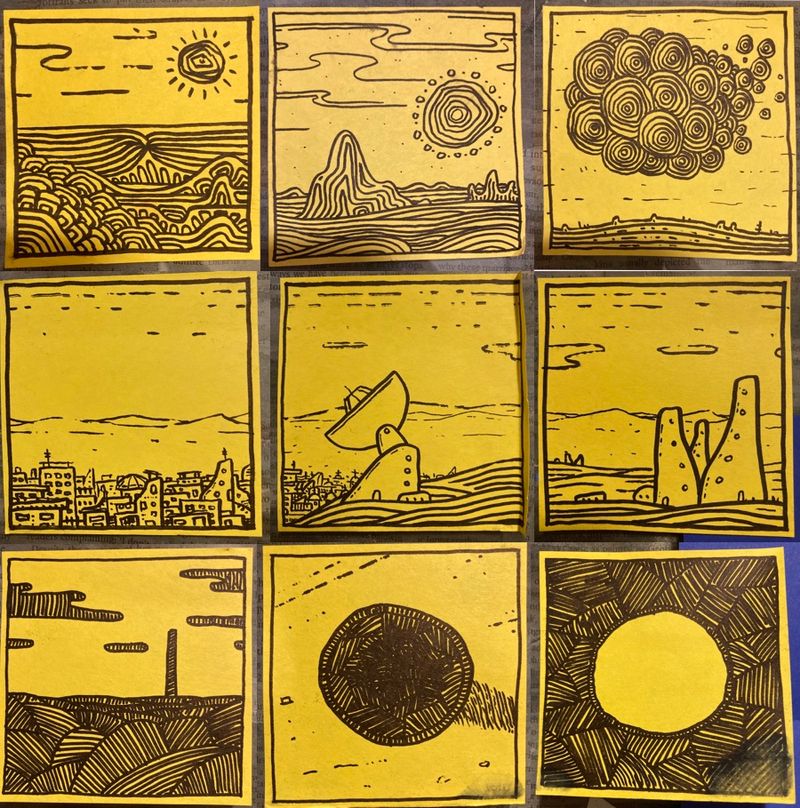
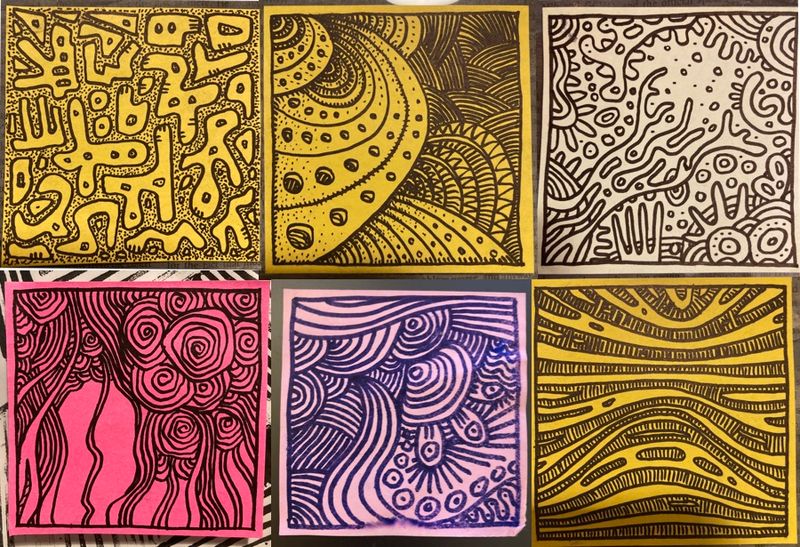


I'd drawn them to still my monkey mind during meetings (colleagues, I promise, I was listening).
Out of curiosity I wondered whether Gemini would be able to generate new images in the same style, or extend the existing images beyond the frame.
Here's how it fared:


So yes, to some extent, it can.
What I was less sure of was why I would want it to. Doodling is pure pleasure, not something you'd want to automate.
Whilst I would never feel comfortable using them as a final output, I can imagine generating variants of the comic style doodles to get ideas about how to apply the visual language in other contexts, before going on to draw more panels of my own.
4. Language learning I #
My partner is a native Spanish speaker and I would LOVE to learn Spanish in 2026, but wow do I find it hard. I plateaued on Duolingo a few years back, so this year I'm going to try in person classes and book learning.
I wondered if AI could help here too.
The first thing I tried was using Google Antigravity to create a conversation card web app, with three levels of difficulty, similar to the question cards I'd made for designers.

Antigravity is Google's AI-powered coding app - it allows you to create more complex software than Gemini on it's own would, but it still uses Gemini under the hood.
It had no problem meeting my brief. My partner and I can easily access the app it created on our phones over our home wifi network - no need to host it or anything.
It probably requires more Spanish than I currently have to make good use of it, but I can see it coming in really handy later on.
5. Language learning II #
I'd ordered a Spanish grammar book (Complete Spanish: Step-by-Step, by Barbara Bregstein) and started to work through the exercises in it. I wanted to do them by hand as I have a feeling the act of writing will help with retention, but I also want to check my answers easily.
So, I uploaded 2 images to Gemini; one of the exercise from the book, and another of my hand written response to it, then asked it to check my response.

It did a very good job; not just grading my responses but coaching me through the mistakes I'd made and providing follow-up tests to check my understanding.
You can read the full chat transcript here.
This experience felt genuinely convenient and useful. Rather than competing with my offline learning the AI was assisting, augmenting and deepening it. I will definitely continue to do this.
6. Language learning / music making #
This last one was a bit of a curveball.
I was out running, and started reflecting on whether I could use my running time to double-up as Spanish-learning time as well.
OK, there's something a little tragic about this level of life hack, but anyway, I decided to lean in to it and use it as an excuse to explore AI voice generation and live coding music with Strudel.
So, here's the basic idea: Techno, but the vocals are Spanish verb conjugations.
No wait, come back!
I know, it sounds really dumb, but once I'd had the idea I had to see it through.
Here's the end result:
Sure, it's a little derivative and janky, and it just tails off at the end, but it proved the concept I was aiming for, and gave me the excuse I'd needed to have a play with Strudel (which is AMAZING).
Anyway, if you're interested, here's how I did it:
- I got Gemini to generate the text for past, present and future tense verb conjugations for ten of the most common verbs in Spanish.
- I fed that text into the AI voice generator by Eleven Labs. Their free tier had enough monthly credits for this, so it didn't cost a dime.
- I fed the resulting MP3 files into the Audacity sound editor, and had it automatically split them into hundreds of smaller MP3 files, 2 for each conjugation (English and Spanish). There was a bit of manual faffing here, as the process wasn't 100% reliable.
- I found a decent techno template for Strudel.cc (a web-based live coding environment) and imported all the MP3s as samples.
- I tweaked the techno (I wanted it a bit more Basic Channel sounding) and integrated the samples into it, then recorded a live session.
Honestly, this was all way easier than I'd imagined it would be, largely thanks to Strudel. Manually aligning 300+ individual samples to the bars of a track would have been SO tedious, but in Strudel you can do it in a few lines of code.
I went out running with it the next day. Will it work as a language learning tool? I'm not sure to be honest - I have a feeling it's too passive an experience for the words to really stick in my memory.
But anyway, I had a LOT of fun making it.
Reflections #
What to make of all this? These examples are all pretty trivial (I was looking for fun ways to spend the winter break after all) but I hope they hint towards different ways that creatives can use AI without diminishing their own talents or exploiting those of others.
In particular, I think this notion of using AI to create new tools rather than new outputs is a potentially powerful one, and might avoid some of the ethical pitfalls.
It breaks the dependency on the AI, it gives creative control back to the human and feels more likely to produce original, and perhaps even weird and unpredictable results.
However, with all of these examples I didn't have to worry about a bunch of things; I wasn't sharing any sensitive data and the code was only going to be used by me, so I could be more relaxed about it's quality.
This is obviously not true of many scaled-up applications of AI, and nothing here invalidates the many legitimate concerns people have with how the technology is being created and used.
So, that was my xmas break. Hope you all had a good one too :-)